


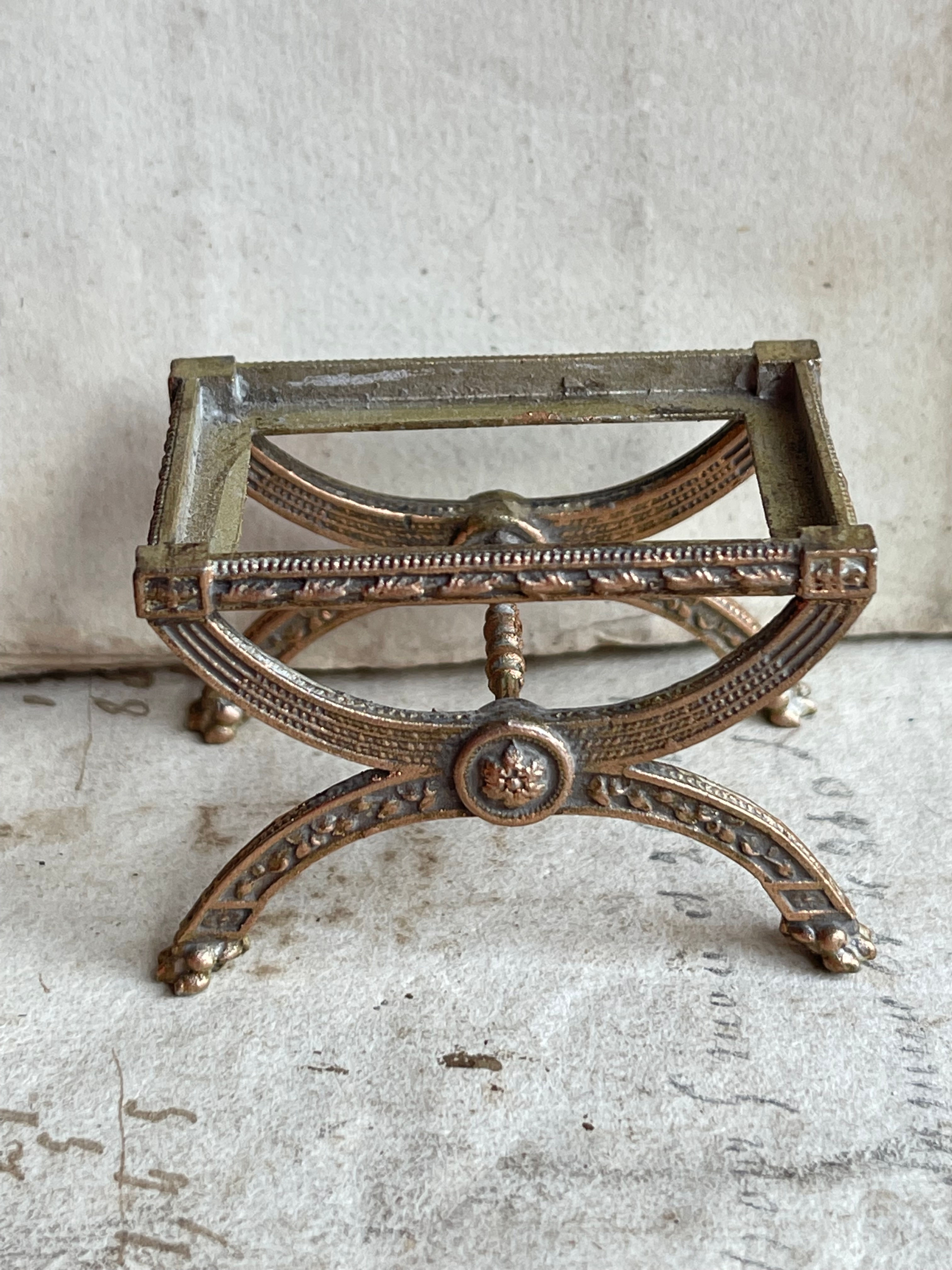

This is a slight 12th scale copy of a folding stool commissioned for Marie Antoinette's Salon des Jeux at Compiégne. We have ommited the side bars at the bottom of the stool.
Here is a little history as the origins of the original full size version: "Twenty-four of the X-shaped folding stools were then sent instead to the queen's gaming room at Fontainebleau. The beechwood frames were provided by Jean-Baptiste-Claude Sené, who was also paid for making a preliminary model. The sprigs and wreaths of ivy, beading, twisted-cord ornament, and lion's-paw feet were carved by the sculptor Nicolas Vallois (1738–1790) under Hauré's direction. Louis-François Chatard painted the furniture an off-white color, highlighting the decoration in gold. A metalworker named Courbin supplied the iron bolts placed at the crossing of the legs so that the stools could be folded (the miniature version does not fold), and one Chaudron gilded the rosette-shaped bosses on the ends of the bolts. Claude François Capin upholstered the stools and applied fringed borders. The firm of Pernon in Lyon wove the fabric for the original upholstery and the matching wall hangings, a ribbed silk chiné embellished with a bower of trees, floral garlands, and hollyhocks on a white ground."
The 12th scale version is in kit form and consists of only 4 parts.
I have shown it unupholstered.
You will need to cut some card or a small piece of wood to insert into the base. I think the seat should have two layers. The insert which should be slightly raised above the side of the stool and then another layer.
NOTES
As with all my metal designs the pieces will require a little cleaning using a file and/or sandpaper. The metal is very soft so this is a simple and satifying part of the build process.
I tend to use superglue (Hafixx being my favoured choice) with a super glue activator to speed things up.
To paint the item I strongly recommend a metal primer. Spray primers are the easiest and just a light coat with give the paint something to 'key' with......then the choice is yours. I use all types of paints from acrylics to cellulose spray paints. All have their own merits and so I choose according to the finish I wish to create.
After applying my coats of paint I will always add an aging layer of raw umber acrylic (water it down and then paint and wipe off to leave the dark paint in the recesses). Aging can be very rewarding and there are many options for this. One little recommendation is to use rotten stone/pumice stone powder to add what I like to describe as "dust" to the piece. It is a powder and will always be a powder unless mixed with a binder such as glue. The powder is a soft grey and if it is brished on then off it will leave a slight dusting in the recesses of the design.
A final flourish of splatter (very subtle brown/grey applied with by splattering the paint from a bristled brush such as a toothbrush) adds a little more interest.
